


1. Mediaite
  2. Gossip Cop
  3. Geekosystem
  4. Styleite
  5. SportsGrid
  6. The Mary Sue
  7. The Jane Dough
  8. The Braiser

FCC Measures Real Internet Speeds, FIOS Wins

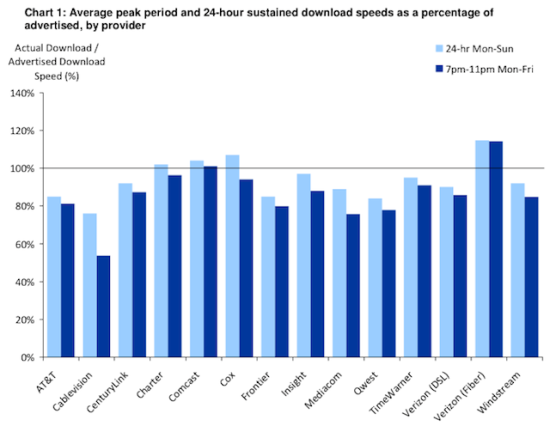
The FCC won’t let me be or let me be me released a study yesterday that outlines some data it has collected, including the actual, for realsies Internet speeds that people get based on provider. The chart you see above provides the most summarized data showing how respective Internet providers live up to (or fail to live up to) their advertised speeds. FIOS is tops, consistently over-performing expectations, while it appears that several others don’t ever meet their advertised speeds and can drop to as low as nearly 50%.

The study notes that “actual download speeds are substantially closer to advertised speeds than was found in data from early 2009,” which is a bit of a double-edged comment. Things are getting better, but we’re still mainly seeing ISPs move closer to advertised speeds.

The data was collected by a company called SamKnows, that has experience with this kind of measurement from work in the UK. SamKnows picked out 78,000 Internet users, set 9,000 up with special routers and collected data over the month of March 2011. It’s interesting to finally see this data in the real world from a source we can trust. I, for one, am beginning to believe the FIOS hype and that beautifully straight little line sure helps. Check out a few more graphs from the study below.
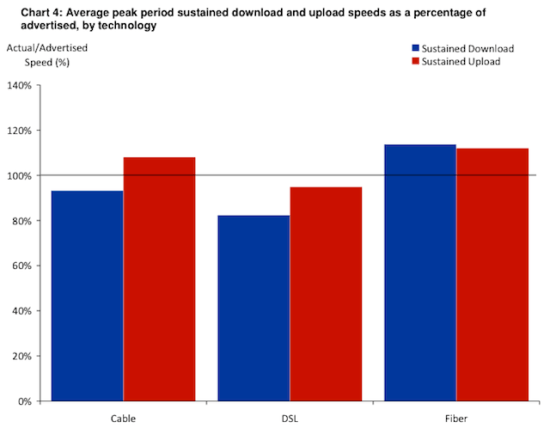
(via Ars Technica)

  • http://www.facebook.com/captainslinky Brian Pierce

    These graphs don’t actually mention speed, they talk about reliability and how close they come to their ADVERTISED speeds… just because AOL consistently delivers on their promise of 28.8kbps via dial-up connection doesn’t really make them the fastest internet, does it? Or am I just reading the graphs wrong… I didn’t see any mention of actual speed…

  • http://Geekosystem.com Eric Limer

    well a percentage of a speed is a speed, isn’t it?

  • http://carebearin.com/ CareBearin

    Mentioning 78,000 and 9,000 is misleading.  Only 6,800 respondents took part in the study (see p10 in the full report), so I’d just use caution when interpreting the results.  According to this site, http://internetworldstats.com/top20.htm, there are 239,893,600 internet users in the United States, so the data actually represents a *very tiny* fraction of U.S. internet users.  

  • http://carebearin.com/ CareBearin

    Mentioning 78,000 and 9,000 is misleading.  Only 6,800 respondents took part in the study (see p10 in the full report), so I’d just use caution when interpreting the results.  According to this site, http://internetworldstats.com/top20.htm, there are 239,893,600 internet users in the United States, so the data actually represents a *very tiny* fraction of U.S. internet users.  


Abrams Media Network click here for advertising opportunities

© 2012 Geekosystem, LLC | About Us | Advertise | Newsletter | Jobs | Privacy | User Agreement | Disclaimer | Power Grid FAQ | Contact | Archives | RSS RSS
Dan Abrams, Founder | Power Grid by Sound Strategies | Hosting by Datagram