


1. Mediaite
  2. Gossip Cop
  3. Geekosystem
  4. Styleite
  5. SportsGrid
  6. The Mary Sue
  7. The Jane Dough

Futurama Writer Created And Proved A Brand New Math Theorem Just For Last Night’s Episode

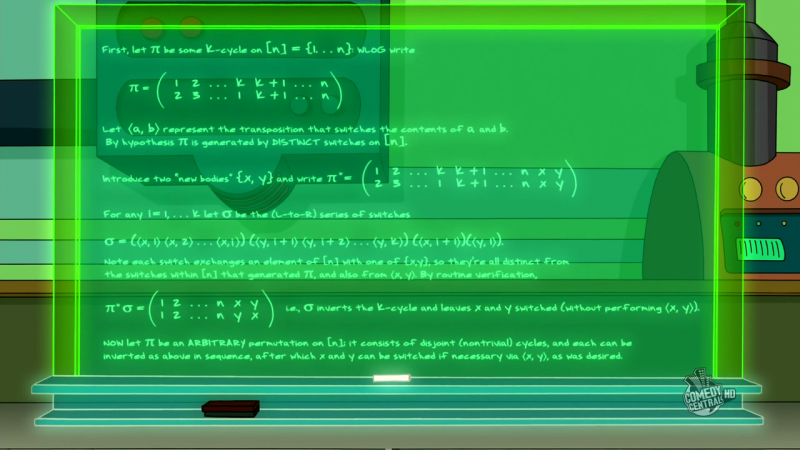
We all knew the writing staff of Futurama was brainy, but this is something else. To work out the ridiculous brain switching plot line from last night’s hilarious episode, writer Ken Keeler (who also just happens to have a PhD in mathematics) ended up writing and proving an entirely new theorem. This is probably the most impressive bit of side work from a TV writer since a writer of Desperate Housewives discovered a new species or the staff of Full House developed a vaccine for a specific strain of syphilis.

In the episode “The Prisoner of Benda,” the Professor and Amy use a new invention to switch bodies. Unfortunately, they discover that the same two brains can’t switch twice and have to come up with some equation to prove that, with enough people switching, eventually everyone will end up in their rightful form. This, of course, leads to much hijinks as well as the grossest sex scene the show has ever done (take that, Prof. Farnsworth and Mom!).

Of course, Keeler decided to go the hard route and come up with a suitable equation himself. It was first teased in an interview that head writer and executive producer David X. Cohen gave to the American Physical Society:

“In an APS News exclusive, Cohen reveals for the first time that in the 10th episode of the upcoming season, tentatively entitled “The Prisoner of Benda,” a theorem based on group theory was specifically written (and proven!) by staffer/PhD mathematician Ken Keeler to explain a plot twist. Cohen can’t help but chuckle at the irony: his television-writing rule is that entertainment trumps science, but in this special case, a mathematical theorem was penned for the sake of entertainment.”

Now that the episode has aired, we can check out the theorem in full. Well, I won’t. I suck at math. But the people over at the Futurama wiki The Infosphere have. If there’s anyone as smart as Futurama writers, it’s Futurama fans.

Now, if you’ll excuse me, I have to go continue to clean that sex scene out of my brain.

(photo via)

  • Polynomials

    I read the proof, and I may be misunderstanding his notation, but I think his proof is incorrect. The error is not trivial, but it is easily correctable. The series of switches he says will produce the desired result is not right; it cycles the indices forward when he wants to go backwards. He could either do the reverse or just cycle the indices in the series of switches backwards one cycle. Someone please correct me if I am wrong. I think I might be misreading the series notation. I really wanted this proof to be correct =/

  • j_grime

    The proof is correct (where you reading the notation from left to right?) If I’m allowed to post a link, I made a video response about this http://youtu.be/8M4dUj7vZJc

  • Polynomials

    You’re right, that was my problem, which explains why I offered the correction I did. Sometimes group/permutation theorists have funky/idiosyncratic notation.

    But I also think what he has proved is not exactly what the article says – he proves that if you have some set of things which is out of order, then you can reorder them into the correct order the appropriate sequence of switches without repeating if two of those things are either in the correct place or transposed with each other at the beginning- these are the “new bodies”. The article seems to make a stronger assertion- that any order can be reconstructed from any other one without repeating a switch. The first step says you can turn some ordering into a k-cycle through the appropriate set of distinct switches *without* (x,y) – you might duplicate a switch involving x or y in that first reordering to get the k-cycle if you do not ignore x or y at first.

  • j_grime

    I don’t know if this answers your question: When you permute n objects (in this case people’s minds) the permutation can be written as a product of cycles. This is true. He then introduce two new people, x and y, and applies his method individually to each cycle in the product of cycles. Each cycle will then be returned to normal. It could be clearer but the proof is sound.

    And if I may, I need to update the link to my video response after the lawyers removed my last one (a little zealous in my opinion as the video is clearly for educational use) This one isn’t as good though http://youtu.be/dow7bWdr_YA

  • einsteiner

    Polynomials, it is possible to create any permutation with distinct switches. Start with the non-scrambled objects, then switch the contents of spot 1 with whichever spot has what you want to be there, then do the same with spot 2 and so on until they are in the order you want them in. These swaps are all guaranteed to be different.

    The proof does have a problem though, it’s that i should be restricted to 1,…,k-1. The algorithm fails if i=k.

  • Polynomials

    Thanks j_grime, that did answer my question. Modern algebra was the class I paid the least attention in college, heh.

  • j_grime

    Polnomials: Ah brilliant, you’ve made my day if I have helped.

    einsteiner, haha! You’re right, that would fail (Note to anyone reading this, it’s not a major problem to the proof, just a mistake).

  • Katie

    I’ms orry, but “grossest sex scene”? That was probably the most hilarious scene in the whole show. Farnsworth and mom was much worse T_T

Abrams Media Network click here for advertising opportunities

© 2012 Geekosystem, LLC | About Us | Advertise | Self-Serve Advertising | Newsletter | Jobs | Privacy | User Agreement | Disclaimer | Power Grid FAQ | Contact | Archives | RSS RSS
Dan Abrams, Founder | Power Grid by Sound Strategies | Hosting by Datagram