


comScore
Uncategorized Thursday, June 10th 2010 at 10:20 am

Microsoft Zings Google Over Suspiciously Bing-y Backgrounds

Last week, Google allowed users to set custom backgrounds on the Google frontpage for the first time, in a move that was more-or-less well-received, though many saw in it a hint of Bing imitation. But while people may enjoy choice, they tend not to like forced defaults: Today, Google is putting backgrounds on its homepage by default for 24 hours, and user response has largely been negative. A quick Twitter Sentiment analysis (using what is unfortunately a rather small sample size) reveals that of the people who have Tweeted about today’s Google background experiment, 86% have conveyed negative sentiments versus only 14% who have conveyed positive sentiments. Let’s just hope this doesn’t lead to any tech support calls.

But customers aren’t the only ones who’ve not exactly cozied up to Google’s background experiment: several Microsoft personnel have zinged Google for its Bing-like background choices with various degrees of wit and annoyance.

Microsoft Europe: “We’ve lost a background image, if found please return to bing.com :)”

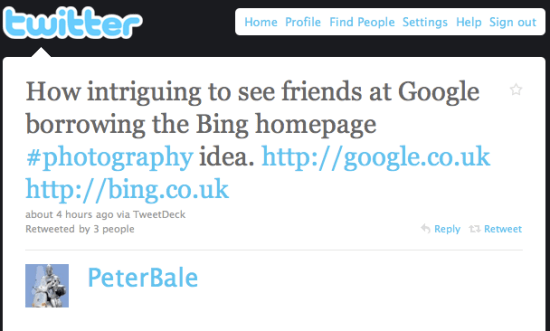
MSN UK executive producer Peter Bale: “How intriguing to see friends at Google borrowing the Bing homepage #photography idea. http://google.co.uk http://bing.co.uk”
Microsoft consumer division managing director Ashley Highfield: “Imitation (however pale) is the sincerest form of flattery: a certain search engine put up the same pic (tulip fields) used on Bing long ago.”

If the Google homepage backgrounds don’t suit your fancy, you can change it back to white by clicking “change background image” in the lower left corner of the homepage, selecting “editor’s picks,” going to the bottom, and picking white. But then, why are you on Google’s homepage in the first place? Save yourself the headache by Google searching directly from your browser bar; it’s built into Safari and Chrome, and you can install it here for IE and Firefox if you don’t have it already.

(Telegraph via TechCrunch.)

Filed Under |
  • http://twitter.com/CRZ CRZ

    Looks like the HTTPS version was left unscathed for now – https://www.google.com – pass it on!

    (Thanks, random dude on Twitter!)

    (Note: if you try it without the “www” it bumps you back to the background image version)

  • Robert Quigley

    very cool — thanks for the tip.

  • http://www.thelyricvault.com LotteMae

    You have to laugh at Microsoft’s response “How intriguing to see friends at Google borrowing the Bing homepage #photography idea”. I’ve lost count of the number of Microsoft hosted seminars that I’ve been to and heard them rave about the new technology that has been invented… when in reality it’s a load of codswollop (sp!?).

    Bing wasn’t exactly a pioneer for “wallpaper” now was it!? “Wallpaper” has been around for many many years and I’m not even sure if Microsoft Windows was the first OS to have that feature.

    As for search engines, maybe some of you remember a fairly significant case a number of years ago where Google tried to sue the one-man web development company that created Groovle. Now that was a site which cleverly utilised Google’s search engine but added wallpaper functionality. It hit the news because the monolithic Google lost on laughable “We are SKYNET” grounds.

    But, if you take that into account, it was Google that indirectly had background wallpaper on their search engine. Yet again Microsoft have stepped in with their big feet claiming they invented it. Yep, right-o.

    Moving on further than the Microsoft/Google squabbling, I don’t think either Bing or Google are that innovative these days with their search engines. In my opinion the beauty of Google is the simplicity of it, and more importantly the efficiency of it. I’m an advocate for the small fry websites that excel in artistic merit as opposed to financial clout. Take the website Gazoomy (http://www.gazoomy.com) for example which lets you set background wallpaper for Google search. It features a dragable searchbar that seemlessly integrates with the background with a slight translucency effect. The image spans both the search and results pages (unlike Google). The images automatically resize depending on your resolution. The perks go on and on… if the big boys wish to be innovative then they need to look at the small fry which are generally better.