

comScore
Uncategorized Monday, April 11th 2011 at 1:47 pm

This Harvard Entrance Exam from 1899 Will Probably Make You Feel Dumb

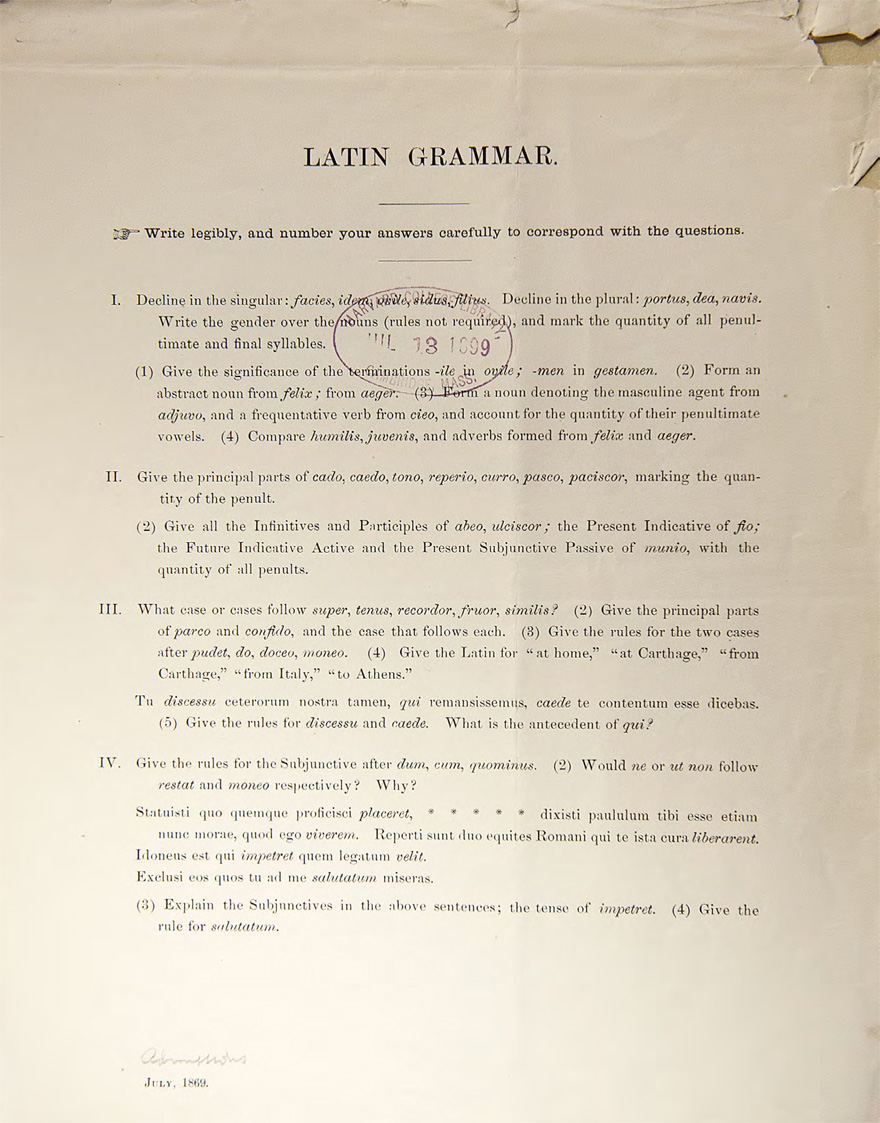
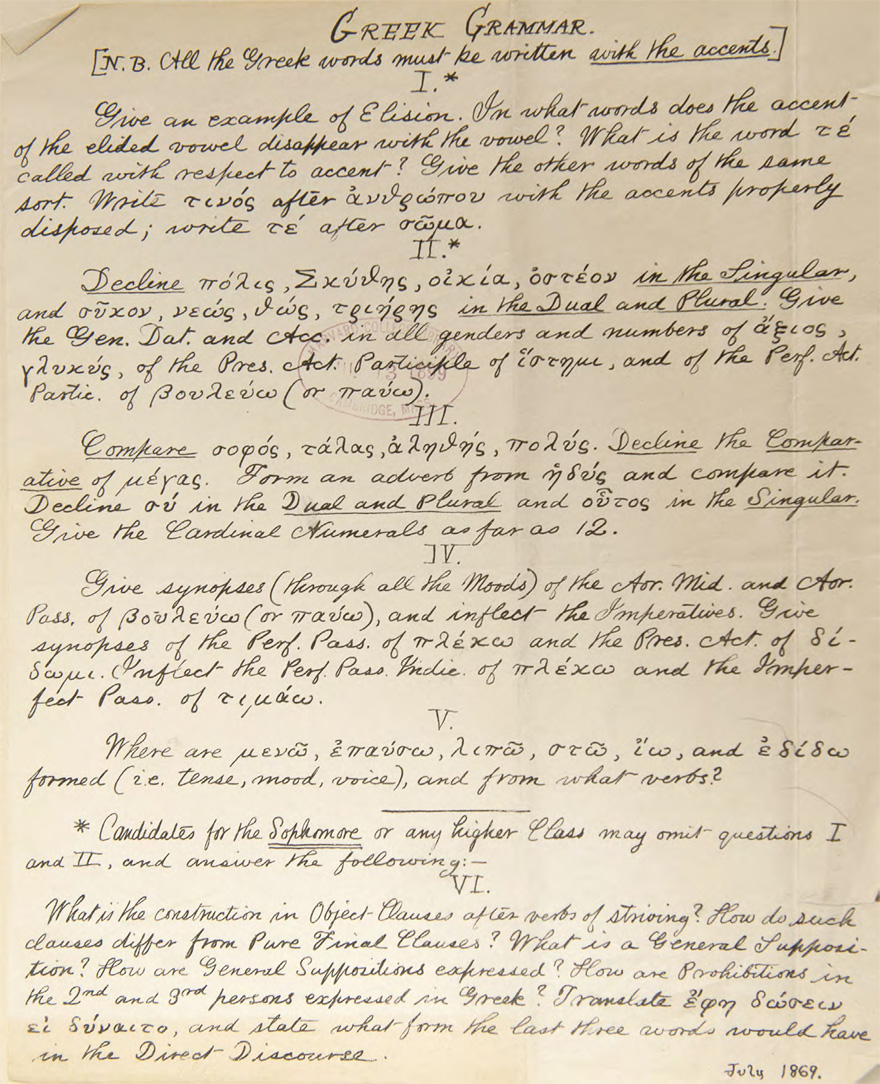
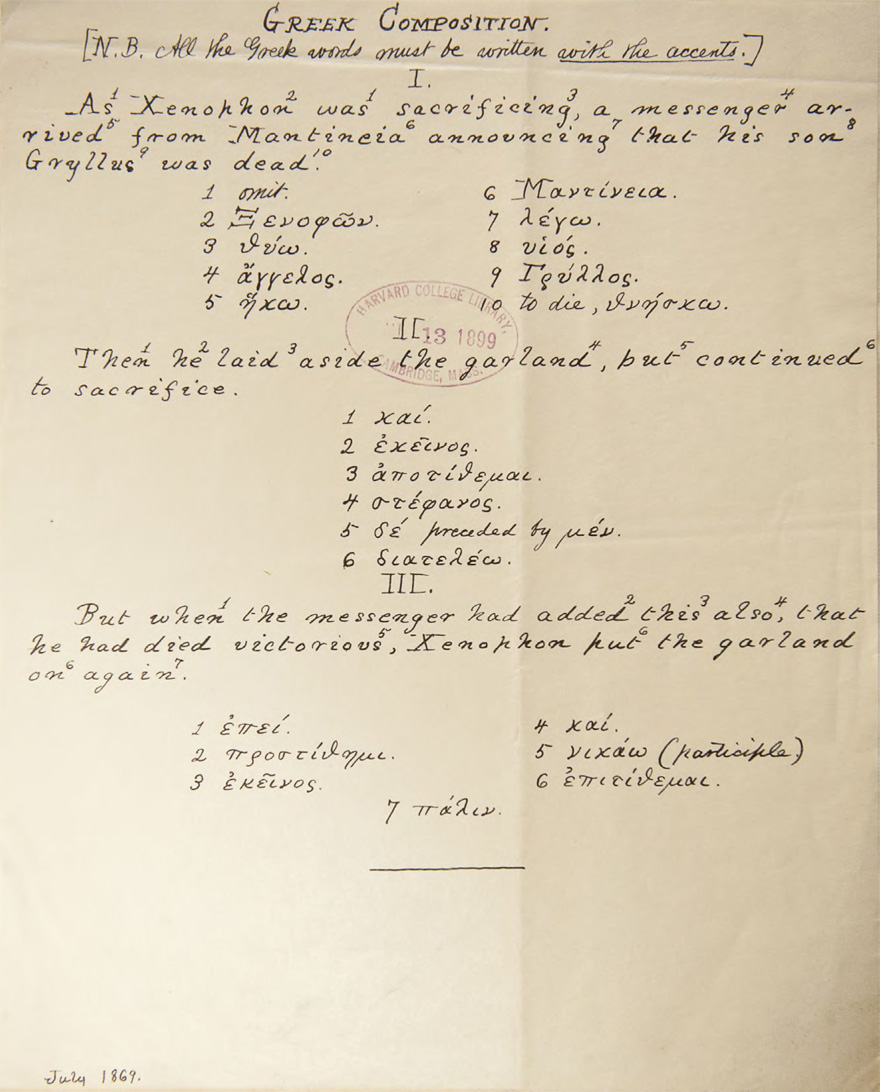
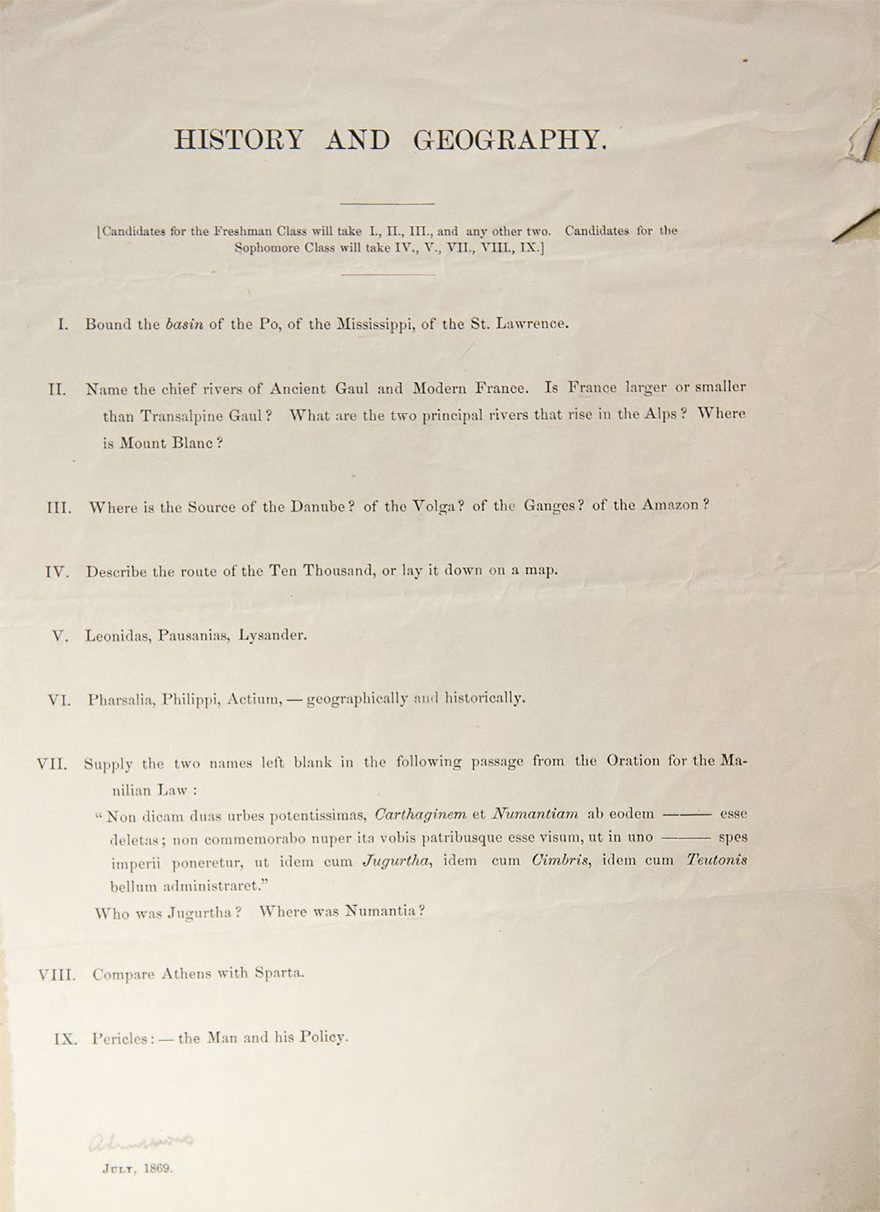
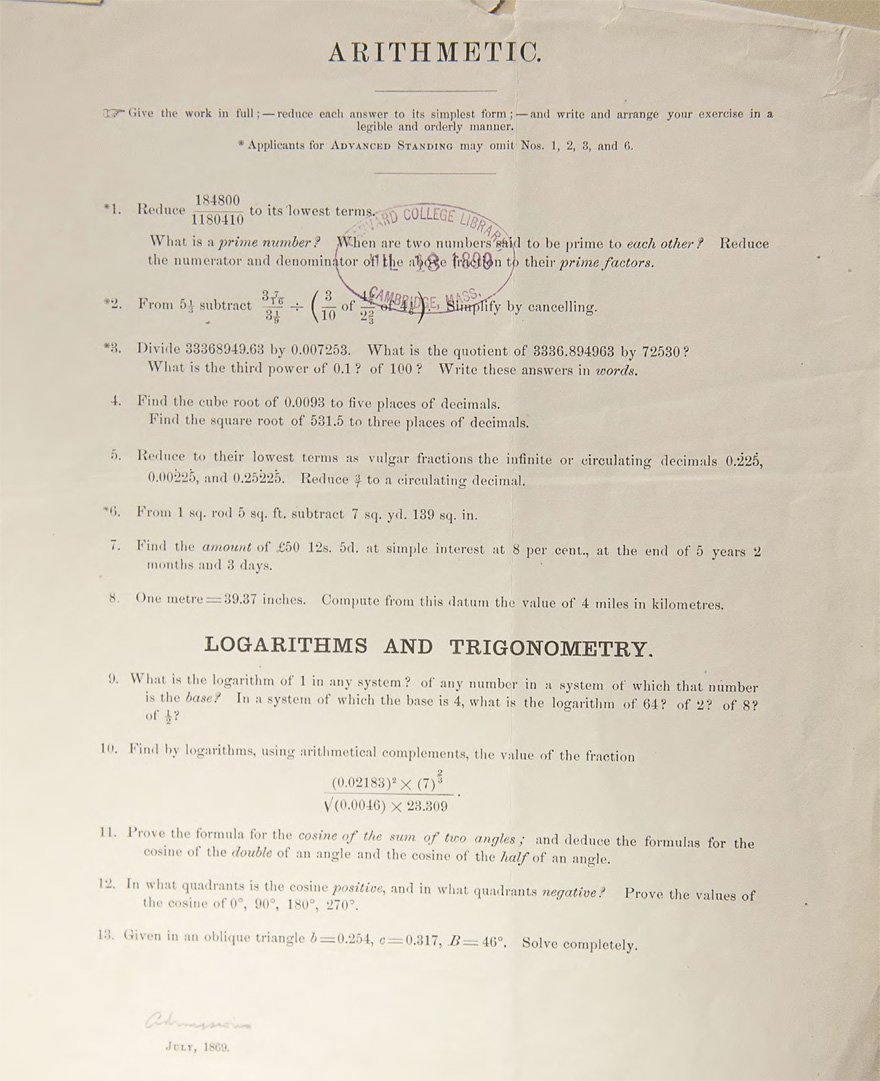
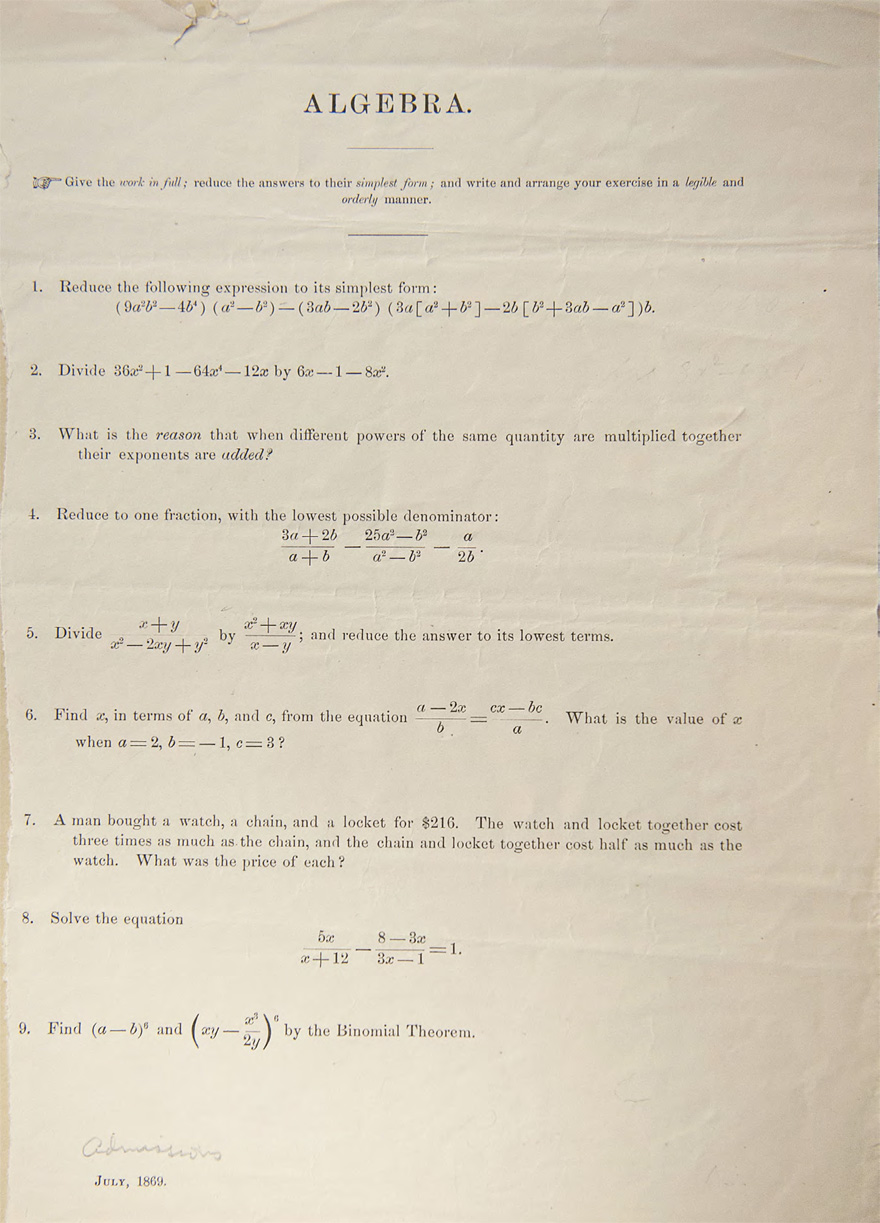
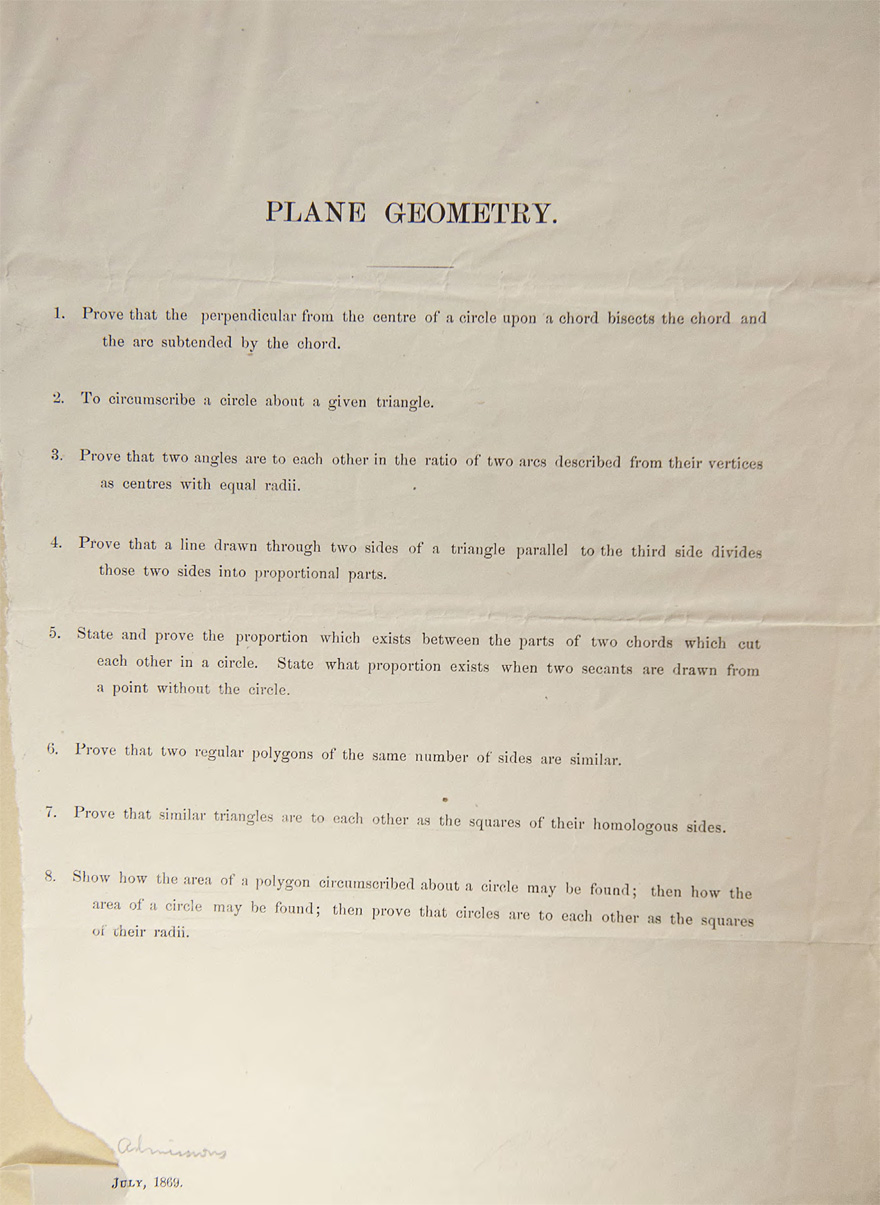
Unless you had a very solid classics education in high school, know the sources of the Danube, the Volga, the Ganges, and the Amazon off the top of your head, and are comfortable tackling some hoary arithmetic and plane geometry without the help of a calculator or Wikipedia, you’re likely to find this Harvard entrance exam from 1899 more than a little challenging. (Thanks to the NYT for digging it up.)

Granted, Latin and Greek were de rigueur for the well-heeled youths of the day — they probably would have been stumped at the Spanish and Chinese that today’s high school students are learning — but there are plenty of college graduates today who would flee in terror at that first polynomial equation.

Full entrance exam below. How would you do?



(NYT via Slashdot)

Filed Under |
  • Corch Urban Meyers

    “there are plenty of college graduates today who would flee in terror at that first polynomial equation.”

    Perhaps this is true of those who majored in garbage and were thus swindled out of a large sum of money in order to receive a diploma of trivial, and laughable, value.

  • Anonymous

    The math is not beyond a competent high school graduate. The geography and history seem within the knowledge of students of Greek and Latin, as many names of places and persons would have been mentioned in the classical language texts.

    So it is the Greek and Latin that intimidate us today, just as I would be intimidated by any questions requiring an expert knowledge of Chinese or Russian.

  • Mathcrack

    much fun with nr.2 and 4 of algebra..

  • http://twitter.com/ircolle Ian Colle

    It’s actually from 1869 – look at the bottom of the pages. The 1899 mark is probably when the library logged it into their archive.

  • A College Dropout

    Holy shit that test is easy. Even the latin and greek isn’t hard if you took a class or two.

  • Tyler

    Yea you should edit this, it’s from 1869, not 1899.

  • gordon

    My kids go to a classical K-12 school that teaches you how to think, rather than how to find a job. They are 3rd and 6th grade and will do just fine on this by the time they are juniors. They began learning Latin in 2nd grade, and will pick up Greek in High School (and French, German, etc). I showed it to them and they both knew all the geography questions and the 6th grader knows some of the Algebra.

    Here you have in bold face just what is wrong with our educational system. We educate to a low common denominator, expect mediocrity, don’t reward the best teachers and put union selfishness and NEA nonsensical curriculums ahead of what is best for students.

    Today we train followers to find jobs, rather than leaders who will be great citizens. Huge difference.

  • gordon

    By the way, kids who learn Latin early have a HUGE advantage in learning other languages and in their scores on the verbal portion of the SAT, etc. Guess we lost sight of that.

  • gordon

    Lastly, the kids in 1869 would lave laughed at the ease of Spanish and would have handled Chinese the same way they conquered Greek, duh.

  • http://twitter.com/shuankay Shuan Khor

    haha, this really isn’t hard. at all. in fact, i did papers harder than this in year 10…

  • http://pulse.yahoo.com/_ZYKMBK5DX5XMS5MBESLAPYTHNU Grace

    I wish I could remember long division just so that I could solve those! (I haven’t used it since college and have forgotten)

  • Yeti

    What does being able to do those ridiculous, completely abstract math equations do for you? How does that make one a ‘leader who will be a great citizen’?

    This is an example of old-fashioned curriculum that was preserved for far too long simply because of academic tradition. I don’t see how any of this is considered relevant.

  • phasor99

    @gordon: a lot of the things on this test are obsolete garbage knowlege that in the modern world is only worthwhile to retirees as a recreational pursuit. i am an engineering major, and i may not have the mechanical arithmetic skills to do some of these problems, (or the trivial historical knowlege of largely useless facts) but i do know how to think. when i need to solve a complex math problem, I often don’t get out pen and pencil, but I look up how to do it and start programming. what’s the point of being able to reduce 2811754/17685 in under 10 seconds when you know how to design and build a graphing calculator? engineering school taught me how to think, but in the process, i acquired marketable, generic skills and a practical understanding of the physical world. My complaint about the school system is that it does not teach enough practical knowlege. there is no motivation to learn about imaginary numbers until you realize that you can use them to solve complex circuits, represent arbitrary signals, and analyze many real physical systems. as far as teaching kids to be “leaders”… i think there are too many cooks in that kitchen. someone taught to be a leader from day one is usually a bad one. good leaders evolve from good followers. we should emphasize discipline and hard work, not stroke egos and delude kids by saying “you know how to think, you don’t need any actual knowledge”.

    “By the way, kids who learn Latin early have a HUGE advantage in learning other languages and in their scores on the verbal portion of the SAT, etc. Guess we lost sight of that.?”

    Yes, the same way that kids who learn spanish would have a much easier time learning italian, or latin for that matter. but why would anyone want to learn latin when they could be learning a language people actually speak? I think you have fallen victim to fashion and are trying to justify an illogical bias.

  • phasor99

    “Lastly, the kids in 1869 would lave laughed at the ease of Spanish and would have handled Chinese the same way they conquered Greek, duh.”

    the kids of 1869 could spend most of their day learning how do reduce fractions and spell greek words. modern kids have many more educational paths to choose from, and specialization is key.

    also, remember that back then, the literacy rates were a small fraction of what they are today. back then, most people cared about how to sustain their farm or earn money to support their family doing mindless labor fit for machines, not human beings. or were you too busy “becoming a leader” to actually read your history books?

  • Reeferal

    These questions aren’t difficult per say. I have to agree with what was said above about being able to solve complex, abstract mathematical equations not correlating to actual ability to succeed in life. W/e.

  • http://twitter.com/StianAsplund Stian Asplund

    For that matter why learn latin and greek rather than chinese, japanese, spanish, portugese and arabic or some other more relevant language in todays modern world? Studying ancient greek culture and philosophy? Need latin for names in biology? Seems too spesific and spending that time on a class on a bigger modern language, civics, critical thinking, literature, engineering, IT, multimedia, science, or some other general area of knowledge that isn’t obscure but relevant in modern society, wouldn’t that be better time spent?

    I’m asking not saying.

  • Sayger2

    Your comments are excellent – and right on! I have 21 grandchildren and each and every one is home schooled. All have done very well. I have several engineers and one with a doctorate in Spanish, accomplished musicians (more than a steel guitar) as well as other fields. All this was accomplished without ANY “compromised” schooling or the help of unionized teachers. The “low common denominator” phrase might better be written as “loweST common denomonitor” – because that is exactly what has happened. NO amount of MONEY will ever help this situation – and that is all that most educators today see as the only way out!
    God help us!
    sayger2 in MS

  • Sayger2

    Yeti:
    I’m not going to disparage your comments intentionally here but let me ask: have you ever read any real classical writings by any of the accomplished thinkers and writers of early America – or Britain – or France or . .. .. .? The “ridiculous equations” and “old-fashioned” curriculum moulded citizens who could actually think and write and vote as intelligent citizens. (please don’t misunderstand me) I do not consider that only this calibre of people should be allowed to vote but I do know that intelligent and well informed (broadly educated) citizens will elect ONLY the same type of citizens into important offices.

    Oh yes, and they tend to INSIST that their offspring are educated the same way.
    Which also is very important to the continuation of society as we know (knew) it.
    sayger2

  • Sayger2

    Yeti:
    I’m not going to disparage your comments intentionally here but let me ask: have you ever read any real classical writings by any of the accomplished thinkers and writers of early America – or Britain – or France or . .. .. .? The “ridiculous equations” and “old-fashioned” curriculum moulded citizens who could actually think and write and vote as intelligent citizens. (please don’t misunderstand me) I do not consider that only this calibre of people should be allowed to vote but I do know that intelligent and well informed (broadly educated) citizens will elect ONLY the same type of citizens into important offices.

    Oh yes, and they tend to INSIST that their offspring are educated the same way.
    Which also is very important to the continuation of society as we know (knew) it.
    sayger2

  • durr hurr

    You have to look up how to solve complex math problems? You don’t know how to derive these results yourself? Congratulations–you didn’t learn how to think; you learned how to look stuff up. That’s not exactly rocket science, I hear.

    Also, designing and building a calculator isn’t thinking for yourself–it’s a very simplistic schematic that follows a very basic set of rules.

    Typical “engineering student” who only knows how to solve textbook type problems. He doesn’t understand that thinking critically and analytically (aka thinking) allow one to derive everything he’s capable of doing for themselves when they should need it. He will thus probably just work in a plant doing maintenance/”quality assurance” and never actually contribute any real developments to his field.

  • Larrysing

    All you people “poo-pooing” how “EASY” this is are being disingenuous. The average public high school grad in the USA would CHOKE on this test.

    Thank gosh there are charter schools and private schools which still give kids a chance to have a really GREAT education, like Tempe Preparatory Academy in Tempe, AZ.

  • love

    Thats a hell of an assumption to make about a person’s intelligence and future. Do you know why people can’t do well on this exam? The subject matter is no longer relevant. Yes, I would LOVE to learn Latin or Greek, but the truth is, there is extremely little demand for people in that field. Also, how can you possibly fault someone for using computer programming to solve problems? its called efficiency. You can light a fire using flint instead of a lighter, but why the hell would you? We have created machines, search engines, and research tools so we don’t have to waste time doing long division or solving proofs, and we can continue to develop as a species and build off what others have learned before us. I believe that strong analytical skills are very important, don’t get me wrong, but we as “kids today” are not soft and do not have it easy because we do not have to do these things by hand. The truth is that we do not have the luxury to choose. In highly competitive fields, you must follow, or create, the most efficient method or you will get trampled and left behind.

    and other commenters: Yes, we are trained to find jobs. I don’t understand how this is a fault. I think it would be a sign of stupidity to go into a field that no work exists. What exactly does one do then? Have a life living paycheck to paycheck? and still not doing what you truly want to do? We choose these professions for their security, not because we are thrilled about the idea of working there for the rest of our lives. Once security is achieved, we can do things we wish to do, say learn Latin or Greek. It sounds as if you are saying mediocrity is borne from hard work.

    I am 3 weeks away from receiving my master’s degree, and I can probably only do about 1/3 of these questions correctly. They are absolutely not relevant to what we need to know now. There are about a million ways to teach children to think critically without these, so please don’t act like we are ruined without knowing how the hell to treat a log without a calculator.

  • unhappyelf

    I at one time or another could solve all the problems on this test but the language ones. However, because we had tools like computer and calculators my knowledge of long division and other mathematical proofs have long since gone. This does not mean I am stupid, not in the least. What is does mean is that I NEED TO LOOK IT UP. Stop lying to yourselves america. If you had learned this all at some point the odds of you remembering when your daily life consists using a computer all day for your job(aka computer engineer), are zero. That does not make me an idiot, instead I remember how to do things that are important for me, like how to interface and LED display made in china with a Controller board made in Korea.   

  • Anonymous

    And you dropped out?

  • CMCTRAUMA

    What an example of the “dumbing down of America!”

  • http://profile.yahoo.com/LXHFNVM6EWNBWXTVDCQLPLKNUI Jess

    Wow, this entrance exam has more Useless info than Jeopardy.  No wonder people like Steve Jobs, Bill Gates, Disney, Ford, , Edison, Jesus, Buddha, never finished college

  • A354000486

    Maths is very easy, even to a Junior One student…..

  • Sa

    **sigh**
    Okay. The fact that Latin and Greek are not widely taught in schools today is lamentable. That is true. But this test emphasizes rote memory, not aptitude. Learning the sources of the Danube, Ganges, Amazon? That only takes a few minutes. The history is similarly easy.
    To see this thread filled with elitist luddites strikes fear into my heart. Why learn about Pericles’ conception of Democracy, specifically? How is the ability to distinguish between two Ancient Greek cities indicative of any greater intelligence? This is a test of content, not of skill. It’s a relic of a dead, obsolete educational system.
    The purpose of this test is not to cull, but rather to ghettoize. A poor teenager in the 1860s might do well on the Math portion of this test, but, essentially, if you didn’t have an expensive education in the classics paid for by your parents, you could not attend the best universities. Even today the Ivy League stands not as a beacon of hope for America’s future leaders — its best and brightest — but instead as an elite institution created to alienate its lower-class masses. This is stratification at its most hideous, and espousing this method is abhorrent.
    Shame on those of you who laud the education this test promotes. View it as outmoded. Old. It has no place in modern education.
    Pedagogy has advanced, not retreated. We teach our children comprehensive and widely-applicable skills because they provide the soundest basis for future specialization. This is the way of the present. The way of the future.

  • Jacopo Barberis

    I swear, I could have really easly done the mathematical part and I’m in highschool in Italy, I though Harvard was a freaky geniouses college.

  • vddfd

    Seriously? That’s for high school.

  • Colin Taylor

    I don’t believe you.

  • Just a guy

    Latin and ancient Greek provide the base for most modern languages. Learning these makes it much easier to pick up quickly on more relevant languages. As for the study of ancient Greek culture and philosophy, these subjects teach us to think in an abstract manner, so that when tackling something like an engineering problem we might be able to see the problem and approach it in a different way.