

-
Space
The IAU Isn’t Pleased With Uwingu’s Exoplanet Contest
As you might recall, Uwingu is holding a contest to name an exoplanet. People love naming stuff in space, but it has rarely been in the hands of the people to decide. It's typically left to the International Astronomical Union (IAU) to assign designations. It's pretty much their job. They're not too keen on Uwingu taking money from folks in order to give a name to an exoplanet that won't be officially recognized as such, and they've said as much in a recent statement.
Read on... -
Space
New NASA Planet Hunter TESS Searches Entire Sky, Puts Kepler To Shame
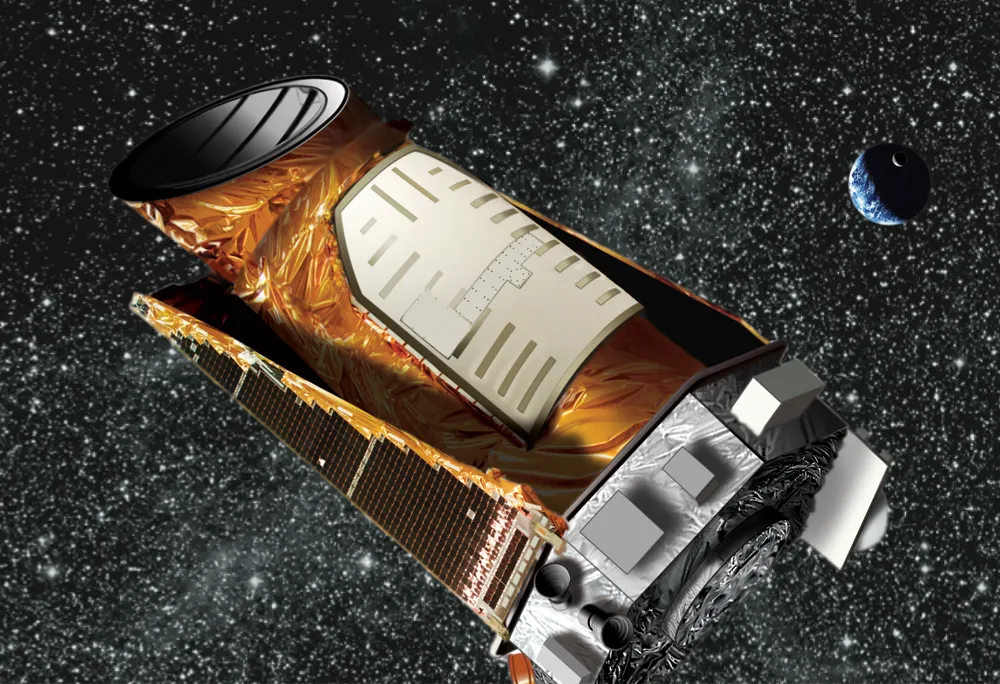
We've already spotted more than 800 exoplanets beyond our Solar System, and more than a hundred of these were identified by NASA's Kepler mission in the four years since its launch merely by observing one small swath of sky. But now NASA has its sights on even more worlds with the newly green-lit Transiting Exoplanet Survey Satellite (TESS), a spacecraft set to launch in 2017. Hit the jump to find out what makes this one so different.
Read on... -
Space
Is This the First Picture of IRL Tatooine?
A team of astronomers in France believe they have captured the first direct image of a distant planet that orbits a pair of binary stars. It's probably not a lot like Luke's home planet of Tatooine, though, as the enormous object is a gaseous body more than 10 times the size of Jupiter, and leaving the scientists who captured the image still trying to figure out whether it's a huge planet or a tiny star.
Read on... -
Space
If You’d Like to Name an Exoplanet, Now’s Your Chance
We're living in a time when geeks are milling about the foreground of society, unchaperoned -- where we get to exert our fanaticism in various directions. For example, it used to be that newly discovered astronomical bodies were given dry or alphanumeric names, but not anymore! Recently, non-scientist dorks are allowed -- if unofficially -- to name far-flung celestial objects. Just ask Pluto. Today, Uwingu is sending out a call out to name the most recently discovered exoplanet, and you can pay to enter the contest.
Read on... -
Space
Small World: NASA Kepler Mission Finds Smallest Exoplanet Yet
What can we say, folks -- some days, all the cool news comes from space, and this is one of those days. On a day that has already brought us revelations about nearby stars and details of the latest mission to Mars, NASA's Kepler mission to seek out habitable exoplanets announced that it has turned up it's smallest find yet -- Kepler-37b, a teeny, tiny exoplanet about 210 light years away that is just a little bit larger than our own Moon.Read on... -
Space
New Definition Boots Earth Out Of ‘Goldilocks Zone’ for Habitable Planets
As researchers sift through reams of data looking for the telltale signs of planets orbiting other stars in our galaxy, special attention is paid to planets in the so-called 'Goldilocks Zone' that could conceivably support life. In the interest of improving and honing the search for Earth-like planets, a team of astronomers led by Penn State University has proposed some changes to the 'Goldilocks Zone' that they think paint a better picture of where life-sustaining planets would orbit in relation to their stars. There's just one problem -- that new definition kicks the Earth's orbit nearly out of the new 'Goldilocks Zone,' meaning that we are all going to have to move to a planet that could support life, as this one clearly can't. Get packing, everyone.Read on... -
Uncategorized
New Potentially Habitable Exoplanet Discovered in (Relatively Speaking) Nearby Tau Ceti System
Astronomers have discovered five new planets orbiting the nearby star Tau Ceti, and there's even better news -- one of them could potentially support life one day. While there are a couple things to be excited for, that's a big "potentially." What's more, it's not as if "nearby" is not exactly down the block in absolute terms. At just 12 million miles away, though, it's just a stone's throw away, as far as the cosmos are concerned. Considering that we're running out of ways to doom this planet, it's never too early to start looking for a new one to ruin a little farther down the line.
Read on... -
Uncategorized
Kepler Telescope Discovers 41 New Exoplanets
With Curiosity getting so much attention lately, it 's easy to forget that NASA has just oodles of other cool stuff going on right now. Yes, most of it does not involve skycrane drops or lasers or HD pictures of the surface of an alien world, but it is still cool, you guys! Case in point: NASA's Kepler mission announced today that is has found 41 new exoplanets in 20 star systems. The results are preliminary and some are still being peer-reviewed to ensure that they are planets and not blips in the data or just alien civilizations messing with us. If they pan out, though -- and there's every reason to believe most of them will -- it will raise the number of planets discovered by the Kepler mission by nearly 50%, to a grand total of 116 planets.Read on... -
Uncategorized
Researchers Observe Planet Swallowed by Star, Offer Terrifying Sneak Preview of Earth’s Fate
We all have plenty of things to worry about and be frightened by in the course of a given day. Paying the bills, getting to work on time, making sure we don't step in front of a bus while texting. Apparently, though, researchers at Penn State University think we could all use one more thing to have anxiety over: The Earth will eventually be swallowed by our own slowly dying sun, just as the red giant star BD+48 740 did to one of its planets. It's the first time that astronomers have been able to observe, in some way, the consumption of a planet by its aging star. Sure, that fate is probably 5 billion years in the future for the Earth, when we'll all be long in the ground, but knowing it certainly doesn't make us sleep any more soundly right now.Read on... -
Uncategorized
Kepler-11′s Planetary Transition Translated to Sound
We have loads of astronomical data on various planetary systems that sits on shelves that only a select few folks actually seem to be interested in. That isn't to say it's not a fascinating area of research but books can only reach so many people. But what if we were to translate this data into musical chords? YouTube user Unfuzified has done exactly that with the Kepler-11 system. The six planets are given a pitch based on the distance from their star and the volume is determined by their size to form a fascinating sonata.
Read on... -
Uncategorized
All of the Exoplanets, to Scale, Courtesy of xkcd [INFOGRAPHIC]
One of the best things the comic strip xkcd does is present the mind-bogglingly large in a beautiful, elegant way. This time, the webcomic's artist turned his eye to exoplanets, presenting all the other worlds we've yet discovered in one image, to scale. There sure are an awful lot of them.Read on... -
Uncategorized
Astronomers May Have Found Most Populous Exoplanet System
In 2010, astronomers announced that they'd discovered at least five -- or as many as seven -- exoplanets orbiting the sunlike star HD 10180 in the constellation Hydrus. Now, a new analysis of that data suggests that there are least seven planets, but as many as nine orbiting the distant star. If true, this would make the HD 10180 the most populous exoplanet system yet discovered.Read on... -
Uncategorized
Planet Hunting Kepler Probe’s Mission Extended Through 2016
If there's one thing space nerds love to complain about, it's the state of the NASA budget. Thankfully saved from the chopping block is the Kepler mission, which since 2009 has been searching the skies for exoplanets with remarkable success. What may surprise some is that Kepler was meant to be a 3.5 year mission to seek out strange new worlds. Thankfully, the probe's hunt for alien worlds has now been extended until 2016.Read on... -
Uncategorized
Super Earth-Sized Waterworld Confirmed By Hubble Telescope
Discovered back in 2009, exoplanet GJ 1214b has been the focus of interest from the start. One of the first planets discovered to have an atmosphere, there's been a lot of guessing as to exactly what kind it actually has. In 2010, tests showed that the atmosphere was primarily composed of water, and now infrared spectra taken by the Hubble Space Telescope have confirmed that it is in fact a waterworld and a planet unlike any other that has been previously discovered.
Read on... -
Uncategorized
NASA Discovers First Earth-Sized Planets Out of Our Solar System, Unfortunately Not in Habitable Zone
NASA's Kepler has found the first earth-sized planets orbiting a star outside of our solar system. Unfortunately for extraterrestrial life enthusiasts, the planets are too close to the star, so they are not in the star's habitable zone. Dubbed Kepler-20e and Kepler-20f, the planets are in located a distance from the star that liquid water could not exist on their respective surfaces, however, the planets set a record for being the smallest exoplanets found orbiting a star similar to our sun.
Read on...