

1. Mediaite
  2. Gossip Cop
  3. Geekosystem
  4. Styleite
  5. SportsGrid
  6. The Mary Sue
  7. The Jane Dough

Planets

Scientists Discover New Super-Earth Within Habitable Zone of Nearby Star

An international team of scientists has discovered a new super-Earth orbiting a star only 22 light years away. The orbiting planet has a an orbital period of around 28 days and a minimum mass 4.5 times the size of Earth. Most excitingly, the planet orbits its star within a zone where temperatures are within the right range for water too exist, neither too hot nor too cold, otherwise known as the habitable zone.

Read on...

“Orphan Planets” Without Solar Systems May Be More Numerous Than Stars

While we tend to think of planets as orbiting stars, as in our own solar system, according to a recent survey of the Milky Way galaxy, the findings of which were published in the latest issue of Nature [paywalled], the universe may be abundant with rogue planets that drift alone through space, with no central star.

The astronomers behind the survey discovered ten so-called “orphan planets” roughly the size of Jupiter at the heart of the Milky Way. But what’s more interesting than the planets they discovered are the implications of their discovery: As the planets were discovered within a relatively small swath of the galaxy, it’s likely, based on their ‘population density,’ that free-floating planets outnumber the stars.

Read on...

Planets with Two Suns Could Have Black Vegetation

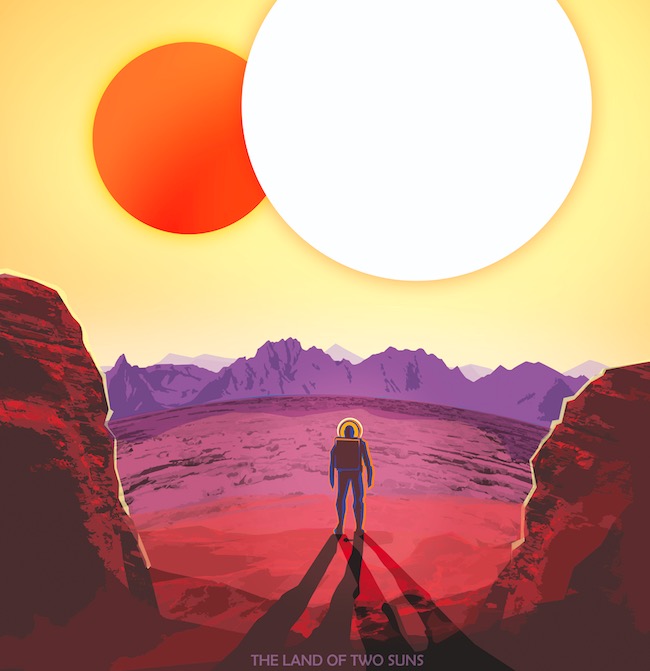
The more you know: According to research presented at a meeting of the Royal Astronomical Society, two-sunned (bisolar?) planets, should they be capable of supporting vegetation, would be likely to have black or grey plants instead of green greenery.

While this may sound like a needless layer of sci-fi whimsy, the optical reasoning they present seems sound enough: “To maximize energy absorption for photosynthesis, especially when the suns have vastly different colors or if at least one of the suns is dim, plants—or, more correctly, their extraterrestrial analogs—may use one or more types of light-absorbing pigments that absorb across a broad range of wavelengths, which would tend to make the plant appear black or gray.”

So: More suns means wavelengths means more light-absorbing pigments, and with fewer wavelengths to be bounced back at our retinae as a result, a blacker coloration would result. Not exactly the sort of research one can easily lab-test, but a fun thought-experiment either way.

(Science Mag via Slashdot. pic via Wallpaper DJ)

Imagine Jupiter Filling the Entire Sky [Video]

After being inspired by the recent lunar eclipse, Brad Goodspeed wondered what the sky would look like if the planets in our universe were as close to Earth as the moon is and revolved around us. And it would probably amaze us while, at the same time, scaring the crap out of us. Imagine if he’d included all 63 of Jupiter’s moons? Ouch.

(Click through to watch in HD.)

(BradBlogSpeed via Neatorama)

Read on...

This Is the First Confirmed Photograph of an Alien Planet

A picture that the Gemini Observatory took in 2008 has just been officially confirmed as the first direct photograph of a planet outside our solar system. While we have images of other alien planets — a.k.a. “exoplanets” — such images have been composed via indirect means of observation, such as gravitational fluctuations, rather than as true photographs.

This particular planet is about eight times the mass of Jupiter, and orbits the star 1RSX J160929.1-210524, which is located about 500 light-years away. The unnamed planet is the little orange dot in the upper-left-hand quadrant of the photograph above.

Read on...

NASA Drafts Our Prime Directive

NASA has an Office of Planetary Protection. It’s where the Officer of Planetary Protection works. And that may be the most awesome thing I’ve heard all week. Goodnight everybody!

…Just kidding. But there really is an Office of Planetary Protection at NASA, and its job is to keep us from irretrievably screwing up interaction between terrestrial life and extra-terrestrial life (or possible extra-terrestrial life).

Boing Boing has an article up about the ever-changing job of creating the protocol that we use to avoid horrible science fiction disasters.

Read on...

A Living Planet: Avalanches on Mars

We usually think of the other planets in our solar system as relatively peaceful, unchanging. It’s sort of a “tree falls in the forest” situation. If there’s no life, how active can they really be? The storm on Jupiter is a swirling maelstrom, sure, but it’s a swirling maelstrom that’s been around for over two hundred years.

And yet… spring is approaching the northern hemisphere of Mars, thawing the carbon dioxide ice that’s built up along cliff faces. And when you get thawing ice on cliff faces, you also get…

Avalanches.

Read on...

Abrams Media Network click here for advertising opportunities

© 2012 Geekosystem, LLC | About Us | Advertise | Self-Serve Advertising | Newsletter | Jobs | Privacy | User Agreement | Disclaimer | Power Grid FAQ | Contact | Archives | RSS RSS
Dan Abrams, Founder | Power Grid by Sound Strategies | Hosting by Datagram