-
Space
Sun Continues Impressive Activity, Tosses Coronal Mass Ejections at Earth
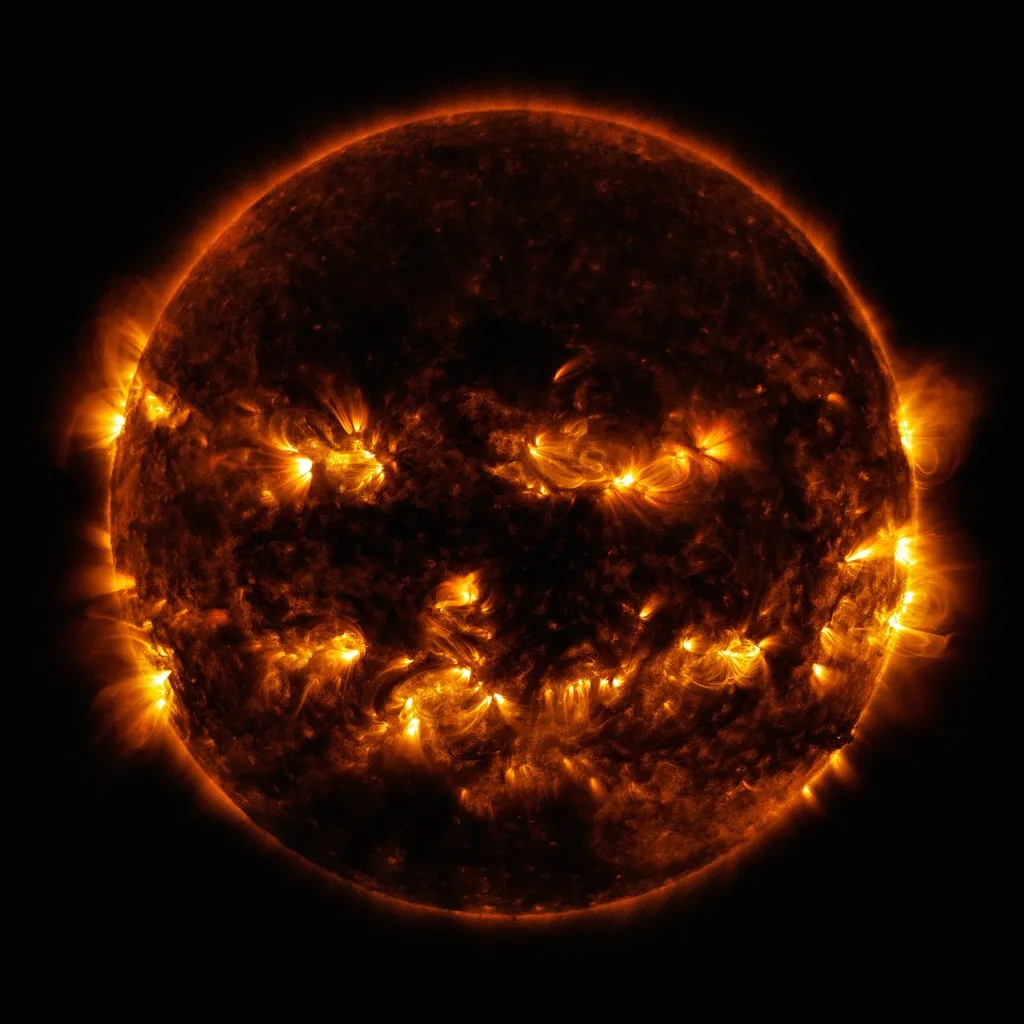
If you weren't already aware, the Sun's been seeing a whole lot of action of late. Like, it's still being the Sun, but it's also putting out incredible X-class solar flares, complete with coronal mass ejections. The latter doesn't necessarily require the former, though, and that's where we find ourselves at currently. Thanks to a couple of coronal mass ejections yesterday, there's a good chance we're going to get some geomagnetic storm activity over the next few days.
Read on... -
Space
Sun Erupts With Three X-Class Flares in One Day, Complete With Coronal Mass Ejections
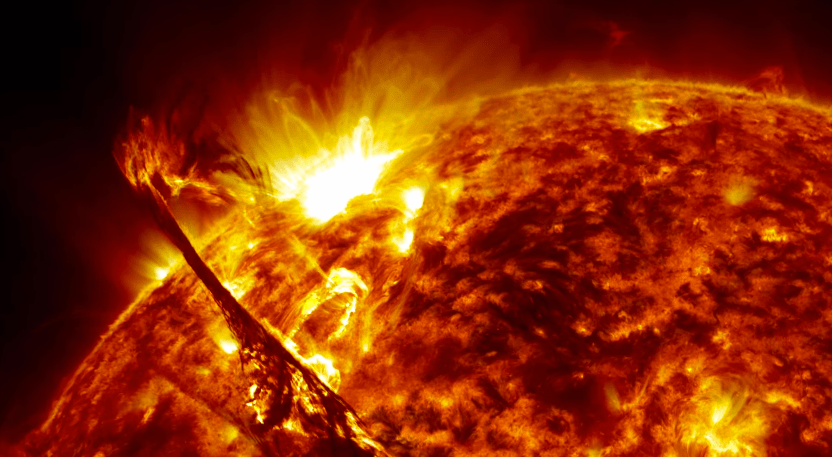
The Sun is ramping up towards its peak activity in its 11-year-cycle, and it's doing so in a big way. In one 24-hour period, the Sun has erupted with three progressively more intense X-class solar flares from the same region, each with its own coronal mass ejection. The CMEs are not heading in the direction of Earth, but could affect some spacecraft.
Read on... -
Space
Twinsies! Alpha Centauri A Has A Cool Outer Layer, Just Like Our Sun
The Sun, it will surprise no one, is very, very hot. What is surprising -- and consistently baffling to researchers -- is that there are certain parts of the sun that are actually rather chilly. You know, in comparison to the rest of the Sun, which, as we've covered, is just exceedingly warm. The European Space Agency's (ESA) Herschel observatory may have made a stride or two towards understanding the strange phenomenon, though, as it has recorded the first evidence of a similar cool outer layer in a star that isn't the Sun. The same cool layer has been observed for the first time in Alpha Centauri A, a relatively nearby star noted for its similarities to our own Sun.Read on... -
Space
The Sun Has Been Dotted With Sunspots This Week, Here Are Some Beautiful Pictures Of Them
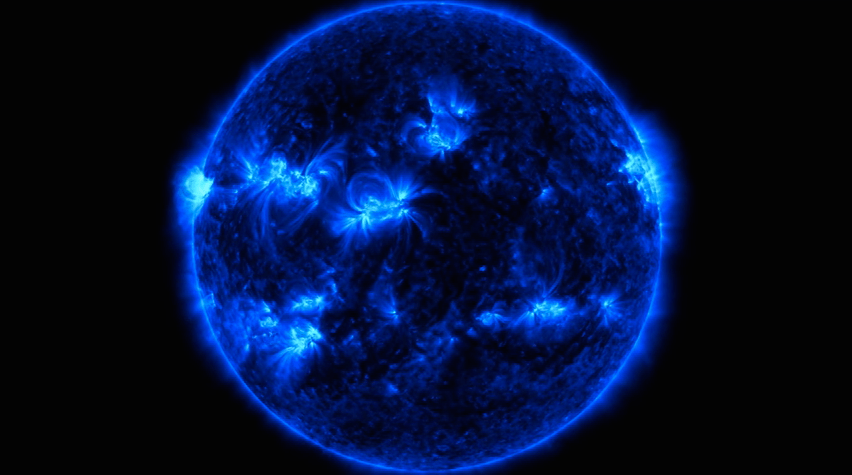
This amazing photo of the Sun -- taken by astrophotographer John Chumack through a filter that renders it blue, and would probably make a really good tool if you ever needed to defeat Superman -- shows some of the dozens of sunspots that have been flaring up on the surface of the Sun over the past few days. Chumack snapped some pictures through a couple different filters, and you can actually see the sunspots -- which show up as white spots in this image -- more clearly in the photos below. While you're at it, you can get a look at new video -- courtesy of NASA -- that will get you as up close and personal as you can be with the Sun and still not be vaporized. What can we say, we just couldn't resist leading with a bright blue picture of the Sun.Read on... -
Uncategorized
New Potentially Habitable Exoplanet Discovered in (Relatively Speaking) Nearby Tau Ceti System
Astronomers have discovered five new planets orbiting the nearby star Tau Ceti, and there's even better news -- one of them could potentially support life one day. While there are a couple things to be excited for, that's a big "potentially." What's more, it's not as if "nearby" is not exactly down the block in absolute terms. At just 12 million miles away, though, it's just a stone's throw away, as far as the cosmos are concerned. Considering that we're running out of ways to doom this planet, it's never too early to start looking for a new one to ruin a little farther down the line.
Read on... -
Uncategorized
Space Porn: NASA Releases Detailed Simulation of the Moon’s Phases
The Scientific Visualization Studio at NASA has released a new animation of the Moon going through its phases for the year 2013. New data from the Lunar Reconnaissance Orbiter has made it possible to render the simulation with a new level of detail, and the result is just gorgeous. NASA set the video to Rossini's "String Sonata No. 3 in C Major," but we've found syncing it up to Dark Side of the Moon works nicely, too.
Read on... -
Uncategorized
The Sun Has Massive, Fiery Tornadoes Several Times the Size of the Earth
Imagine, if you will, a vicious tornado. Now imagine it's made out of fire. Now imagine that it's several times the size of Earth. Finally, that it's in space. Allow me the great pleasure of informing you that what you just imagine exists on the Sun. That's right, there are mammoth fire tornadoes on the sun, enormous, flaming sun tornadoes. These absurd solar windstorms were spotted by some researchers in the UK using the Atmospheric Imaging Assembly telescope mounted on the Solar Dynamic Observatory (SDO) satellite. Somewhere, Micheal Bay is kicking himself for not coming up with sun tornadoes on his own.
Read on... -
Uncategorized
Massive Solar Storm to Reach Earth Tomorrow, Massive Solar Flare Captured in HD [Video]
A huge solar flare that has erupted from the Sun has unleashed a massive solar storm that is headed toward Earth, and predicted to reach us tomorrow morning around 7 AM EST. A storm as powerful as this one hasn't been seen in more than five years, and the effects of which are predicted to last 24 hours after the storm hits. It's possible that the storm will cause interference with satellites in orbit and power grids on Earth, but people in the know don't seem too worried. The above video of the solar flare, captured by the Solar Dynamics Observatory, is a gorgeous side effect of potentially dealing with interrupted power grids tomorrow. Good trade-off, right?
Read on... -
Uncategorized
Less Sunspot Activity Is Not A Climate Change Fix
Recent reports presented at the American Astronomical Society meeting suggest that the sun may be heading into a period of less magnetic activity with fewer sunspots. Some proponents of this theory believe that the next solar minimum (a normal period of decreased solar activity) may be particularly long, lasting for several decades.
Analysis of a missing jet stream in the solar interior, fading sunspots on the sun's visible surface, and changes in magnetic activity of the corona and near the poles suggest that an inactive period may be on the way. But the studies presented are a long way off from receiving scientific consensus. In fact, as Andrew Revkin of Dot Earth points out, there those in the astronomical community who think the evidence presented does not necessarily lead to the conclusion that there will be a long solar minimum. So then media reports of a solar minimum that would solve the climate change crisis, come as a bit of a surprise.Read on... -
Uncategorized
Stunning Explosion Rocks The Sun [Video]
The Sun is no stranger to solar flares (explosions of magnetic energy) or prominence eruptions (gas bursting from the surface) but the combination solar flare/prominence eruption that recently exploded on the Sun has created an astonishing and visually remarkable eruption.
The video of the explosion was captured by NASA's Solar Dynamics Observatory. According to Phil Plait of Bad Astronomy the explosion could have blasted a billion tons of material away from the Sun in a plume as big as the Sun itself at perhaps over a million kilometers across.
From the video, it appears that plasma was released from the Sun's surface, in a fountain of particles that spread outward and then collapsed back down to the Sun. Blasts like this are capable of shooting material away into space, but Earthlings needn't worry. This particular blast was aimed away from Earth (as are most events like this.)
(Geeked On Goddard via Universe Today and Bad Astronomy)
Read on... -
Uncategorized
Comet Hits Sun, Cool Explosion Coincidental [Video]
In case you needed more proof that the sun is not the smiling, yellow, jolly ball in the sky that you saw in your childhood coloring books, take a look at the video above. In it, a comet flies straight into the sun, but the massive orb of flaming gas more-or-less responsible for the beginning and continuation of life on this planet doesn't even flinch. That big burst? Just a coronal mass ejection that occurred coincidentally. The comet is probably from the Kreutz group, the remnants of a larger comet that broke up when it cruised to close to the all-consuming death ball in the center of our solar system. While this kind of event probably happens all the time, that doesn't make it any less impressive. (NASA via Gizmodo)
Read on... -
Uncategorized
Discovery’s Last Silhouette
There are many photos of various spacecraft traversing across the disk of the sun as they orbit the Earth. However, this one is special. This picture, taken on March 1 by Alan Friedman, shows the Space Shuttle Discovery midway through its final mission. A poignant image, to be sure. Discovery will be landing tomorrow, March 9, ending decades of service. It is the oldest of the remaining orbiters, and it will be the first to roll off the tarmac and into history. But no post would be complete without some obligatory educational content. Try this on for size, from Discover Magazine:[...] see that sunspot cluster on the left? It looks to be about the same apparent size as the ISS… but it actually spans a region as big as Jupiter!
(Alan Friedman via Discover Magazine)Read on... -
Uncategorized
For the First Time in History, We Can See Both Sides of the Sun
For the first time in human history, we can see what's going on on both sides of the Sun at once, thanks to NASA. In 2006, the space agency launched two probes into space, jointly called STEREO (Solar TErrestrial RElations Observatory), to monitor the Sun; now that both are in position, we can see the front and back of the Sun simultaneously, and will be able to do so for the next eight years. Unlike the Moon, which has a so-called "dark side" never visible from Earth, we see the Sun's entire surface over the course of a month. But being able to see front and back at the same time is a big help; not only does it mean we won't be surprised by a damaging solar flare, but it gives us more data for understanding how the big ol' ball of stellar nucleosynthesis works. Phil Plait explains:
Events that happen anywhere on the Sun can have a ripple effect everywhere else… literally. A solar flare is a vast explosion on the Sun’s surface, releasing as much energy in a few minutes as millions or even billions of nuclear bombs. This sends gigantic seismic waves, ripples, across the Sun’s surface, affecting other regions. Gigantic coronal mass ejections (CMEs) are like hurricanes over the Sun, and the region causing one can extend onto the far side of the Sun where we can’t see it. Solar prominences and other features can be huge, stretching across the face of the Sun, again hiding part from view. And, of course, in astronomy more is better. Having a better view, a better vantage point, just plain ol’ more data, is a big help.
Nifty video below:Read on... -
Uncategorized
A Robot Named R2 Will Be at the Super Bowl Today
Well, if you thought you were too nerdy to be a part of Super Bowl Sunday, how about this: A robot. Named R2. Will be featured in the pre-show at 2:00 PM EST on Fox. Why? Because R2 (full name: Robonaut 2) is going to be the first humanoid robot to travel into space. And that's not the only awesome space-related event of the day. Today, we're going to see pictures of the entire sun for the first time ever.
Read on... -
Uncategorized
Which is Bigger: The Earth or the Sun? 5% of Men, 10% of Women Say “The Earth”
From OKCupid's recent post on the differences between straight and gay sexuality comes this question with an inexplicable gender gap: Which is bigger: The Earth or the Sun?" About 5% of men say "the Earth"; about 10% of women say "the Earth." Christian Rudder:
Down in the database I discovered one question with a surprising disparity, not between orientations, but between genders. Like Frodo to the Balrog, I wished I'd never unearthed it.
642,533 users is a robust data set, and OKCupid has a reputation for approaching number-crunching earnestly and professionally, even if they use their wealth of data to address oddball or controversial questions. Without resorting to ugly gender-based name-calling, how do you explain this? Do any appreciable number of these people across genders actually believe that the Earth is bigger, or is this some mix of trolling/irony/people being drunk when they're answering OKCupid questions? Do some small number women think that it makes them more desirable to men to act 'ditzy' and ignorant of such basic facts? How, then, to explain the similar result among gay women? Many mysteries. (OKCupid)Read on...