


As wonderful as it can be, YouTube is a nightmare when it comes to rights management. With the millions of people uploading one hour of footage with each passing second, it’s nigh impossible to prevent all copyright infringement. Still, YouTube and rightsholders try, which often results in severely unfair takedowns. There are other methods though, like YouTube’s Content ID, which lets alleged rightsholders slap advertising on videos that allegedly use their content. It’s better than a takedown, but it’s still pretty messed up. A company called BFM Digital, for instance, started slapping ads on a free video because they claimed to hold the rights to originally recorded wind sounds, and YouTube is helping them do it.
Filmmaker M dot Strange is a straight-shooter. Not only did he take pains to make sure that everything in his film Heart String Marionette was wholly original by going out of his way to record his own wind samples, but he also uploaded his entire film on YouTube as part of a “Try before you buy” campaign; he’s a pragmatic creator and rightsholder if ever there was one. BFM Digital, on the other hand, is a little sketchier it seems.
A digital content licenser — much like Rumblefish, who has also pulled this stunt — BFM Digital makes its money by collecting the rights to a whole bunch of things — sounds in this case — and gives people permission to use them, for a price. An increasingly large part of the digital content licensing world these days, in a world of YouTube, is to police the net, see who’s using their stuff without permission, and try to start making some money on it. YouTube’s Content ID helps them do just that by allowing companies to automatically scan uploads and check them against a library of media they ostensibly hold the rights to. If Content ID finds a match, the alleged rightsholder can do one of several things, including slapping ads on the allegedly infringing video. That word “alleged” that keeps popping up? It’s important because Content ID takes rightsholders at their dubious word; if all these claims were vetted, there wouldn’t be any problems.
So, one day, Strange was checking out his YouTubage and found he had an odd notification.
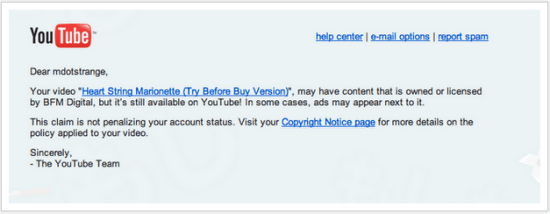
“Basically, YouTube was telling me that they were going to monetize my video without my permission. Someone was going to put up ads and someone else was going to make money off my content,” he told the Daily Dot. His only option for response? “Click here to agree.” Initially YouTube didn’t even tell him what the problem was; it wasn’t until he’d sent an appeal that he learned BFM Digital was laying claim to his wind sounds, the one’s he originally recorded. And for that reason, BFM Digital was putting ads on his video. This is exactly the same thing that happened to a fellow by the name of eeplox when Rumblefish laid claim to the birdsong in his video.
At this point, it’s worth taking a look at the other side of the story. BFM Digital claims that this is a problem with Content ID due to the system’s inability to distinguish between one recording of a bird and a different recording of the same bird or between a recording of this wind gust and that one. Arguably, this probably means that these things needn’t be copyrighted in the first place, but that’s an entirely different can of worms. According to a comment on a story about the Rumblefish thing by a commenter who claims to from BFM Digital, this kind of thing is an unfortunate coincidence and as such, BFM Digital allows sound effect matches from Content ID to expire. It doesn’t, however, do anything to try and prevent them from happening in the first place and before the expiration, the ads still run. How generous of them.
The problem seems to be that by all accounts, Content ID automatically takes action on matches. The whole Rumblefish thing raised some questions as to whether or not rightsholder confirmation was required, but either way, Content ID is facilitating the placement of ads on non-infringing videos. It’s worth noting that this is better than a takedown, because the user isn’t being deprived of their ability to share their work. That said, it brings a whole new level of irony to the situation; while rightsholders freak out at the thought of someone using their IP without permission, we are starting to see rightsholders doing literally the exact same thing when they use Content ID to slap ads on things without confirmation of infringement. In fact, the rightsholders are actually profiting from this misuse, unlike the lion’s share of infringers who just want to put a Stabbing Westward song in their Final Fantasy montage that no one will watch.
In this particular case, Strange circumvented the whole problem by taking an entirely different route to distribute his “try it before you buy it” version, but the whole situation is extremely problematic. It became apparent with the Rumblefish mess, and this instance only confirms it: Content ID, as structured, provides a great opportunity for alleged rightsholders to scam individual uploaders by applying ads “by mistake,” letting the matches languish, or –if you really want to get scammin’ — slapping them up everywhere and letting them sit around until someone complains. Granted, this doesn’t result in the removal of non-infringing content like takedowns do, but in a way, that makes this worse because it makes it a viable strategy for any alleged rightsholder to earn money off of content they don’t own and probably get away with it.
Mark my words, this is going to become an increasingly problematic issue in the future. As always, YouTube’s tendency to favor rightsholders even in the complete and total absence of evidence is extremely detrimental to users. Fortunuately for them, it’s rightsholders that generally carry the most weight and seem to enjoy throwing it around; in fact, it’s big rightsholders that are essentially bullying YouTube into behaving this way in the first place in order to try and protect itself. That aside, there’s always the possibility that a particularly influential user — or another rightsholder — is going to get screwed by this willy-nilly lack of confirmation. Aside from that, it’s just the principle of the thing. Given that these sort of problems started out with takedown abuse and has now moved to Content ID abuse, there’s little to suggest things are going to get better.
(h/t Daily Dot)
- Viacom is engaged in a billion dollar lawsuit with YouTube and pressures them to be overzealous like this
- At least this isn’t a problem in the same way unwarranted takedowns effectively rob users
- Rumblefish was caught doing something like this not long ago